Achieving proper access to the root canal system is a fundamental step in endodontic treatment. Good access not only facilitates the identification and negotiation of canal orifices but also ensures thorough cleaning, shaping, and obturation of the root canals. Without adequate access, there is a higher risk of missing canals, leaving debris behind, or causing procedural errors, all of which can compromise the long-term success of the treatment.
Types of Access Cavities in Endodontics
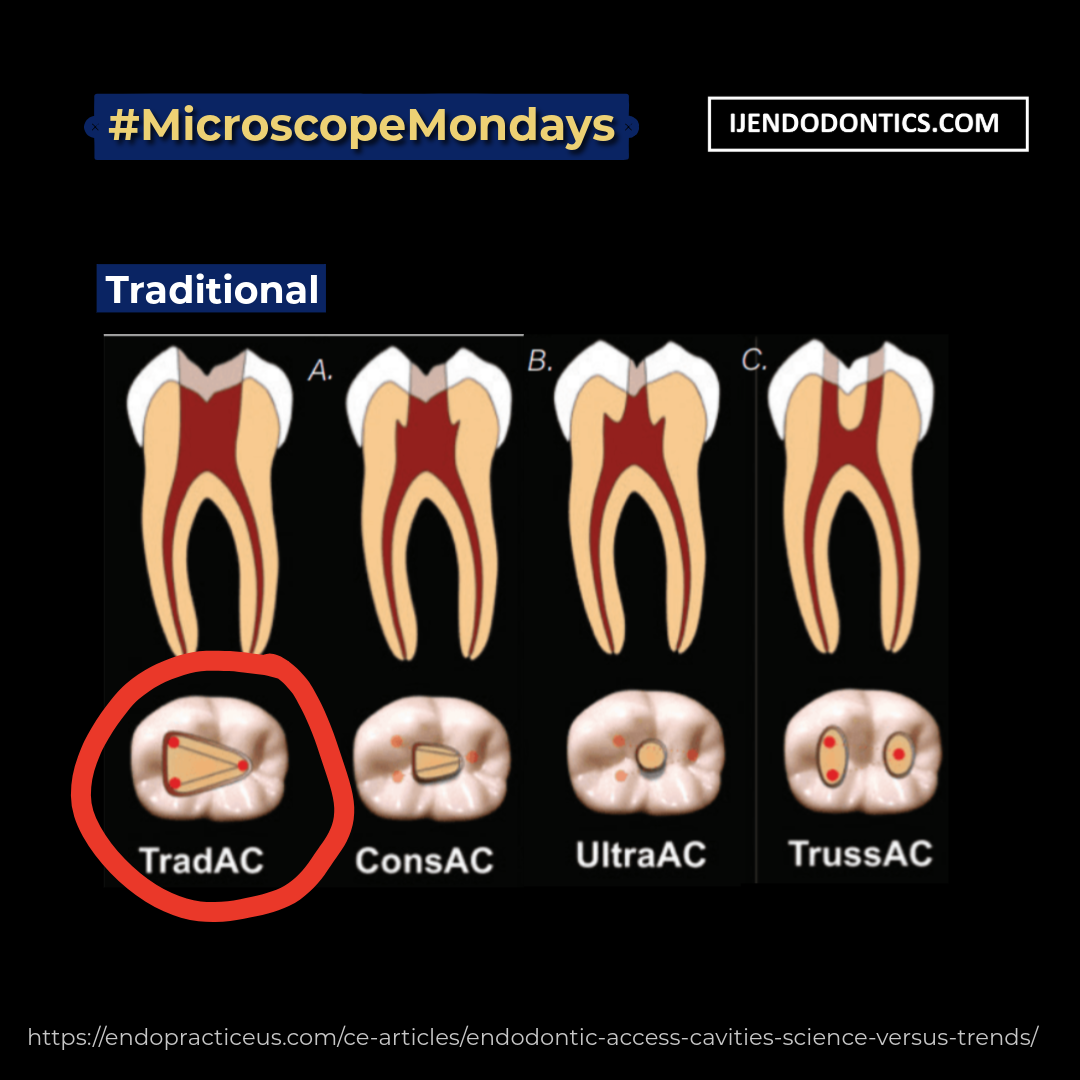
Over the years, several approaches to access cavity preparation have evolved, each with its own philosophy and clinical objectives. The main types include traditional, conservative, ultraconservative, truss, caries-led, and restoration-led access cavities.
Traditional Access Cavity
The traditional access cavity is designed to provide maximum visibility and straight-line access to all canal orifices. This approach often involves removing a significant amount of tooth structure, particularly the roof of the pulp chamber and overlying enamel and dentine, to ensure unobstructed entry and ease of instrumentation.
Advantages: The traditional access cavity allows for excellent visualisation and accessibility, reducing the risk of missing canals and facilitating thorough cleaning. It also minimises the chance of instrument fracture or ledging, as the straight-line access decreases stress on endodontic tools.
Disadvantages: However, this method sacrifices more tooth structure, which theoretically can weaken the tooth and increase the risk of fracture post-treatment. It may also expose the tooth to further restorative challenges, especially in teeth with already compromised crowns.
Conservative Access Cavity
Conservative access cavities aim to preserve as much tooth structure as possible, especially the pericervical dentine, while still providing adequate access to the canal system. This approach is guided by the principles of minimally invasive dentistry and seeks to balance access with preservation.
Ultraconservative Access Cavity
Ultraconservative access cavities represent an even more restrictive approach, often utilising small openings and advanced magnification to locate and treat canals. The goal is to retain nearly all of the tooth’s structural integrity, though this can sometimes make canal negotiation and cleaning more challenging.
Truss Access Cavity
The truss access cavity is designed to maintain the structural “truss” of the tooth, typically by leaving the marginal ridges intact. This technique helps distribute occlusal forces more efficiently, potentially reducing the risk of fracture, especially in molars.
Caries-Led Access Cavity
Caries-led access cavities are dictated by the extent and location of carious lesions. The access is made directly through the area affected by decay, which can help conserve healthy tooth tissue and streamline the removal of infected material.
Restoration-Led Access Cavity
Restoration-led access cavities are guided by existing restorative work, such as crowns or large fillings. The access is planned to minimise disruption of the restoration, often entering through the restoration itself to preserve both the tooth and the restoration as much as possible.
No single design is universally superior. The key is understanding the biological, mechanical, and restorative implications of each approach; and applying them judiciously rather than dogmatically.
Access is not just about entry.
It’s about setting the case up for long‑term success.